

A standalone assignment answers one bounded instructional need. A learning path connects several experiences into an intentional sequence. The better format is not the one with more content; it is the smallest structure that preserves the learning logic and gives teachers useful evidence.
Use an assignment for one bounded decision
Choose a standalone activity for an exit ticket, focused practice, a short diagnostic, homework on one objective, or a common check. It should have a clear start and finish and produce evidence that can be interpreted without requiring several earlier steps.
Use a path when sequence carries meaning
A path is valuable when explanation prepares practice, one representation supports another, difficulty rises deliberately, or reflection depends on previous work. Write the reason for every transition. If activities can be shuffled without changing learning, the sequence may not need to be a path.
Decide how pacing and access will work
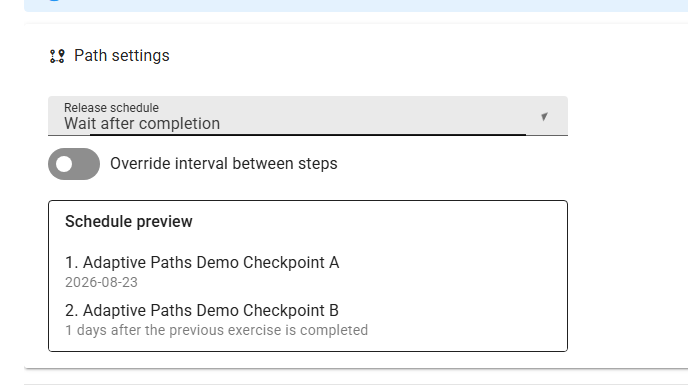
Assignments are simpler to schedule and recover after absence. Paths require a more deliberate choice: should the next step open when the previous one is finished, on its planned calendar date, or only after the learner shows enough understanding? That decision should follow the educational goal, not a preference for tighter control. Also decide what happens after absence, partial completion, a device change, or a missed date.
Place feedback at the right level
An assignment needs useful item and completion feedback. A path also needs orientation: where the learner is, why this step matters, and what comes next. Keep instructions consistent across steps and distinguish feedback that improves the current attempt from evidence used for a later teaching decision.
Match reporting to the structure
For an assignment, inspect participation, question patterns, attempts, hints, and work samples. For a path, also inspect step transitions, common stopping points, time between steps, and whether later performance supports the intended sequence. A path completion percentage cannot explain which step helped.
Choose the smallest maintainable structure
Every extra step creates review, accessibility, translation, scheduling, and update work. Start with a standalone assignment unless sequence adds clear value; begin a path with three to five purposeful steps. Pilot with a small group and revise the transitions, not only the individual activities.
- One need usually means one assignment.
- Meaningful dependency may justify a path.
- Plan absence and partial progress.
- Preview every transition.
- Measure steps as well as completion.