

A learning path answers “what comes next?” A release schedule answers a different question: “when may the learner get there?” That choice changes the rhythm of homework, revision, intervention, and whole-class teaching. Gamena offers three schedules because no single pacing rule fits all four jobs.
First decide what must stay synchronized
Before opening the settings, picture the next lesson. Does everyone need the same background for a discussion on Tuesday? Is the path independent revision that students can finish at different speeds? Does step two rely on evidence that step one is understood? The answer tells you whether calendar time, learner progress, or mastery should control release.
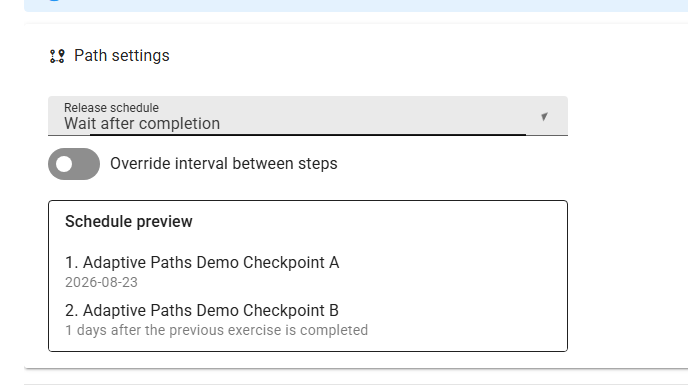
Wait after completion: use it for self-paced sequences
Here, each step waits for the previous one to be completed, then applies the interval you planned between them. It works well for onboarding, independent revision, or a sequence where order matters but the class does not need to arrive together. A learner who starts late naturally carries the sequence forward.
- Best for: self-paced practice and ordered independent work.
- Main advantage: every learner receives the intended spacing after completing a step.
- Watch for: a student who stops early can drift far behind without a calendar signal.
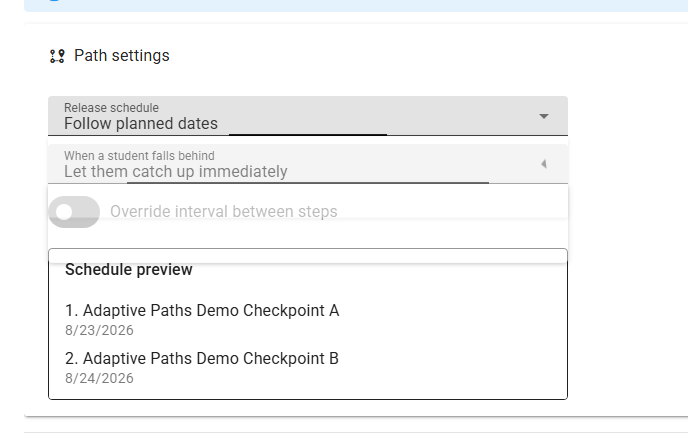
Follow planned dates: use it for coordinated teaching
Planned dates keep the path aligned with your calendar. Choose this when a reading prepares Thursday’s seminar, a lab follows Monday’s safety briefing, or homework should match what was taught that day. The useful extra decision is what to do when someone falls behind. “Let them catch up immediately” opens overdue steps so the learner can rejoin the plan quickly. “Preserve the interval” keeps the intended spacing between steps, even after a late start.
Adaptive Mastery: use it when readiness matters
Adaptive Mastery opens the next step when the student’s first completed attempt reaches the teacher’s threshold. A learner below the threshold receives a focused booster first. Use this when the next activity genuinely depends on the current skill—for example, fraction equivalence before adding unlike fractions—not merely because a score is available.
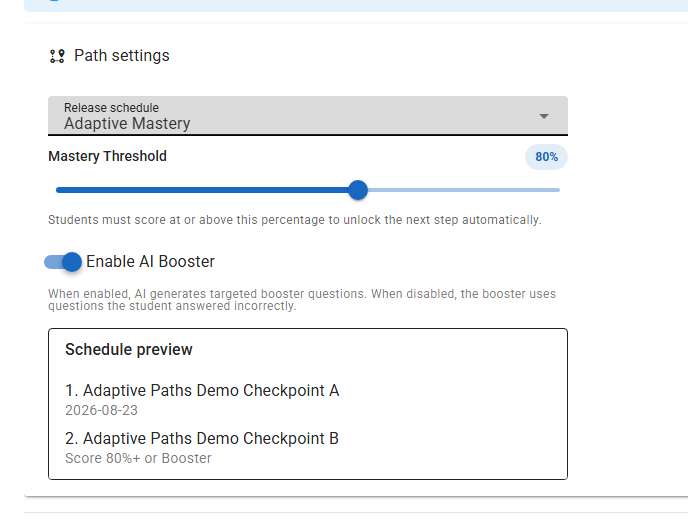
AI booster or copied-question booster?
The AI toggle changes how booster questions are prepared; it does not change who needs a booster. With AI enabled, Gamena generates targeted new questions and falls back safely if generation is unavailable. With AI disabled, the booster copies the original questions answered incorrectly. Fresh questions are better for checking transfer; copied questions are more predictable and keep the practice tightly connected to reviewed material.
A simple decision guide
Choose the least complicated schedule that protects the learning goal. Use completion-based release when students may move at their own pace, planned dates when classroom coordination matters, and Adaptive Mastery when later success depends on evidence from the current step. If two needs compete, split the path: keep shared instruction on planned dates and use a shorter adaptive path for prerequisite practice.
- Need individual pacing after each finish? Choose Wait after completion.
- Need everyone near the same lesson date? Choose Follow planned dates.
- Need evidence before dependent work? Choose Adaptive Mastery.
- Need both coordination and intervention? Use two short paths with different schedules.
What to review after the first run
Do not judge a schedule only by completion rate. Look for where students waited, where late learners accumulated several open steps, which questions triggered boosters, and whether the next activity really depended on the threshold. Then change one thing: the interval, catch-up policy, threshold, or source question. A schedule earns its place when it makes the intended learning rhythm clearer for students and easier for teachers to act on.